The stencil
The Stencil is geohalo's concrete realisation of the operator \(\mathbf{W}\) from
the previous page. It is a frozen dataclass wrapping a sparse
matrix and just enough metadata to apply and validate it.
How it is built
Stencil.compute(lats, lons, geoms) runs a fixed pipeline:
flowchart TD
    A["lat/lon centres + polygons"] --> B["derive cell edges<br/>(midpoints, EPSG:4326)"]
    B --> C["exact_extract → per-cell<br/>coverage fraction ∈ [0,1]"]
    B --> D["cell_areas → R²·Δλ·(sinφ_top−sinφ_bot)"]
    C --> E["weight = coverage × area"]
    D --> E
    E --> F["scipy.sparse CSR<br/>(n_polygons × n_cells)"]
classDef hl fill:#fef3c7,stroke:#b45309,color:#0b1220;-
Canonicalise the grid. Latitudes are flipped to ascending and both axes are checked for regular spacing —
exactextract's raster model assumes a uniform EPSG:4326 grid, and an irregular axis would silently misplace coverage fractions. -
Encode polygons in caller order. Encode the geometries with one vectorised
shapely.to_wkbcall. The resulting binary geometry bytes serve both extraction and hashing. Only hashing uses arepr(key)sort, keeping the canonical digest unchanged. -
Exact coverage. A
NumPyRasterSourcedescribes the grid's bounding box;exact_extractreturns, for each polygon, the list ofcell_ids it touches and the fraction of each cell covered. A WKB feature source passes the binary geometries directly to exactextract, avoiding Python coordinate lists and GeoJSON encoding/parsing. This is the unbiased boundary treatment — see why exact fractional coverage. -
Weight by area. Each coverage fraction is multiplied by the cell's true spherical area, so a half-covered equatorial cell outweighs a half-covered polar one. See latitude correction.
-
Assemble CSR. The
(polygon, cell, weight)triples become ascipy.sparse.csr_matrix— theoccupancy_matrix, in caller row order.
cell_id → grid index
exactextract numbers cells from the top-left with longitude fastest. geohalo
converts back to its ascending-latitude convention with
row_asc = n_lat - 1 - cell_id // n_lon and col = cell_id % n_lon, so the
matrix columns line up with a flat = arr.reshape(-1, n_lat * n_lon) of the data.
Polygon row order
Row i always corresponds to geoms.iloc[i]: stencil.keys matches the input
index, and occupancy_matrix and row_sums use that same order. ReduceOperator
and RestrictedOperator inherit it, as do NumPy and xarray reduction results.
This also holds when loading from LocalCache or RedisCache, even if a previous
caller requested the same polygons in a different order.
Duplicate labels are kept as separate positional rows, not merged. Prefer unique
keys for label-based selection and hierarchy aggregation. MultiIndex levels and
names are preserved. BiasTree retains its own leaves-first node order;
aggregate_bias_with_tree aligns xarray reductions to its leaves by key.
Change from 1.2.0
Older versions sorted polygon rows by repr(key). Remove any positional
permutation that previously undid this sort. To explicitly retain that order:
What a row looks like
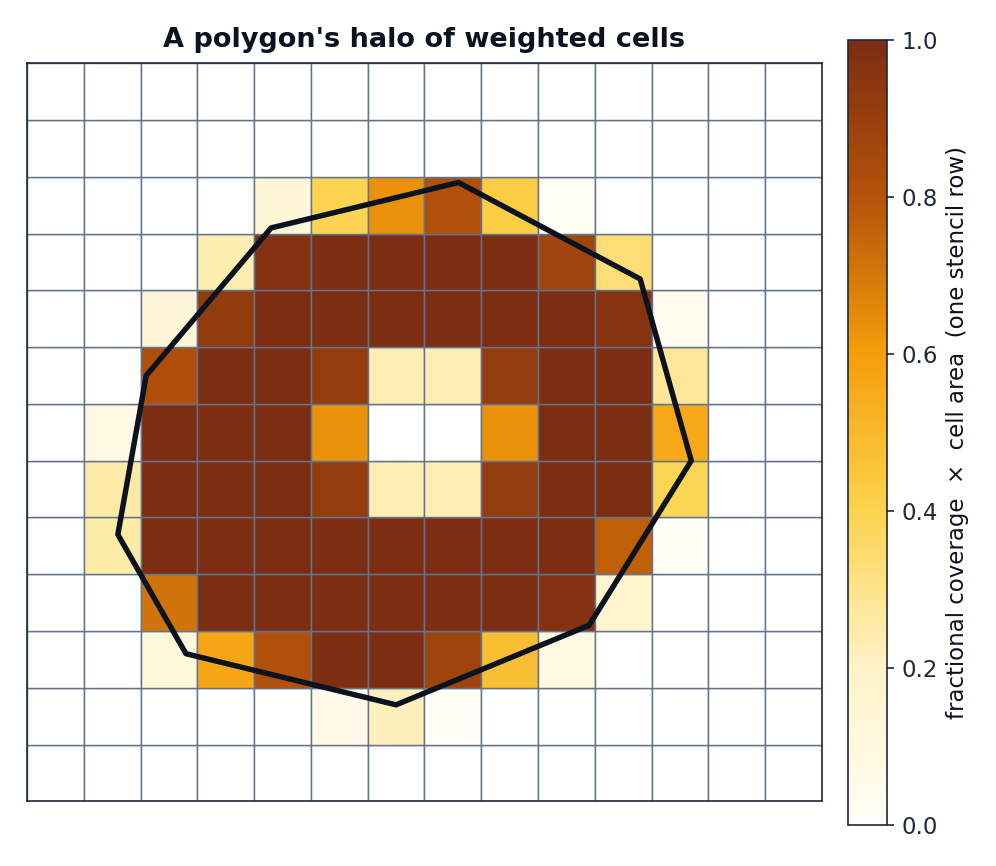
One row of the occupancy matrix is a polygon's halo — the weighted set of cells it overlaps. Interior cells get their full area; boundary cells get a fraction; a hole in the polygon punches the weights back out.
row_sums and normalisation
__post_init__ precomputes row_sums = occupancy_matrix.sum(axis=1) — each polygon's
total overlap area. That vector is the denominator for how="mean", so the mean hot
path never re-sums the matrix.
Stencil.compute(..., dtype=np.float32) stores coverage coefficients in float32;
float64 remains the default. Geometry and area calculations run in float64 before
casting. For float32 matrices, row_sums explicitly accumulates the stored weights
in float64, including after cache reloads. Coordinates remain float64 too.
Only float32 and float64 coefficient dtypes are supported. For smaller output
arrays as well, enable preserve_dtype=True on the reducer; see
coefficient and result dtypes.
Empty overlaps are errors, not silent zeros
If a polygon does not intersect the grid at all — or its overlap area rounds to zero —
geohalo raises EmptyOverlapError(geom_key) rather than emitting an all-zero row that
would later divide to NaN. This surfaces grid/polygon mismatches early.
import geohalo as ghl

try:
    stencil = ghl.Stencil.compute(lats, lons, geoms)
except ghl.EmptyOverlapError as e:
    print(f"polygon {e.geom_key} falls outside the grid")
Cost
Building a stencil is the expensive step — it scales with the number of polygons and
their vertex count, since exactextract clips every polygon against the raster. The
resulting CSR matrix, by contrast, is tiny (kilobytes to a few megabytes) and is what
you cache. See the
Stencil.compute rows in the benchmarks.
Detailed boundaries benefit especially from the WKB input path. Reproduce the comparison against the previous GeoJSON implementation without downloading data:
Both paths include geometry serialization, coverage extraction, CSR assembly, and hashing. The benchmark verifies that matrix entries, row sums, polygon keys, and digests match exactly.
| n_polygons (Brazil L2) | build time | CSR size |
|---|---|---|
| 50 | ~21 ms | 6 KB |
| 507 | ~170 ms | 38 KB |
| 5571 | ~2.1 s | 430 KB |
Once built, applying it to a batch of 50 grid slices takes a few milliseconds.