The fused reduce operator
When you reduce over a refined grid, two linear maps stand between the source data and the answer: a resampler \(\mathbf{T}\) (source → fine grid) and a stencil \(\mathbf{W}\) (fine grid → polygons).
The naive route builds \(\mathbf{T}\), applies it to make a fine field, then applies \(\mathbf{W}\). But \(\mathbf{T}\) spans the entire fine grid — millions of cells — even though only the handful of cells under each polygon will ever survive the multiplication by \(\mathbf{W}\). That is enormous wasted work and memory.
The fusion
By associativity, the two operators compose into one:
\(\mathbf{M}\) acts directly on the source grid. It has only \(N_\text{polygons}\) rows,
so it is tiny — and crucially, geohalo builds it without ever materialising
\(\mathbf{T}\). FactoredResampler.fuse_left(W) pushes the thin \(\mathbf{W}\) through
the resampler's factored form:
and the series is accumulated by right-applying \(\mathbf{G}\) to the thin \((\mathbf{W} - \mathbf{W}\mathbf{P}\mathbf{A})\). Every intermediate keeps only \(N_\text{polygons}\) rows, so the fusion scales to high iteration counts and huge target grids where \(\mathbf{T}\) itself would not fit in memory.
flowchart LR
    subgraph naive ["naive: build the fine grid"]
        direction LR
        X1["source x"] -->|"T (N_target × N_source)"| FINE["fine field<br/>millions of cells"]
        FINE -->|"W"| A1["a"]
    end
    subgraph fused ["fused: one thin operator"]
        direction LR
        X2["source x"] -->|"M = W·T<br/>(N_poly × N_source)"| A2["a"]
    end
Why it matters: the size win
The fused operator is the most compact thing to cache, and — unlike \(\mathbf{T}\) — its size does not grow with target resolution or iteration count.
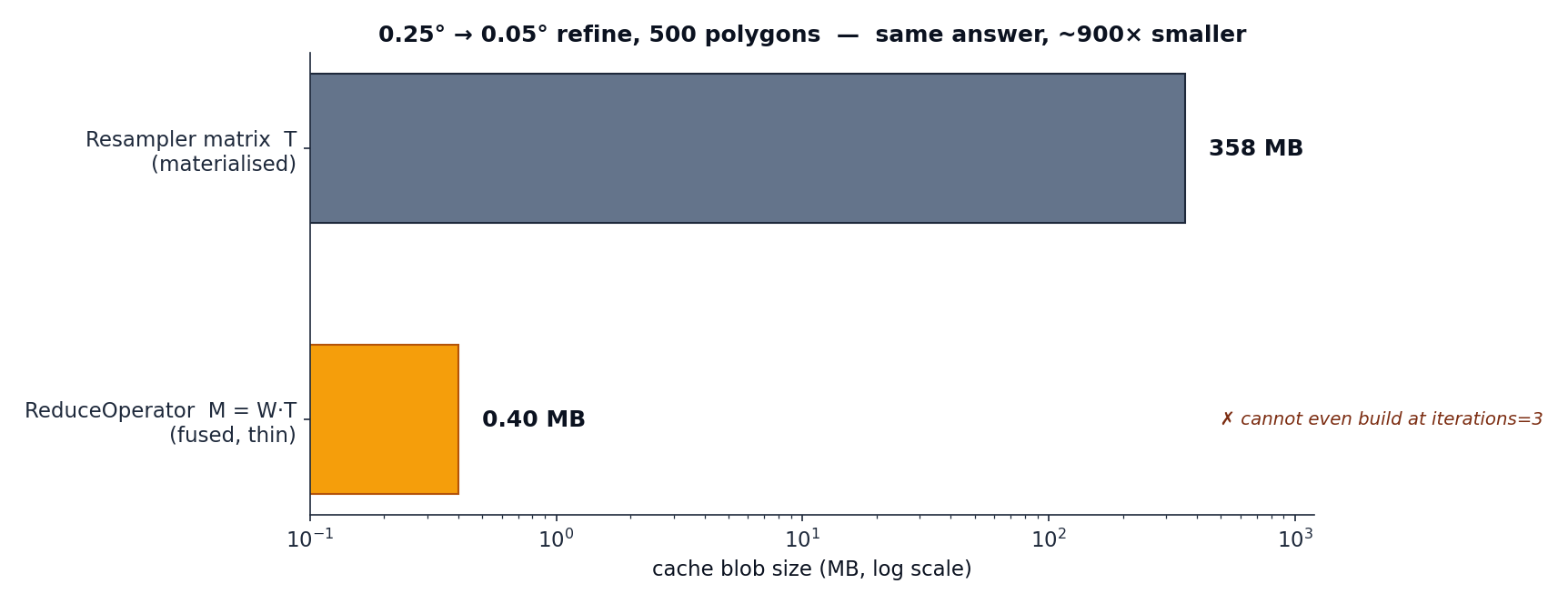
ReduceOperator
ReduceOperator.compute(stencil, source_lat, source_lon, iterations=…) returns the
stencil's own matrix unchanged when the source grid already matches the stencil grid
(no resample needed), and otherwise calls fuse_left. Applying it uses this fused
matrix directly on the source grid:
import geohalo as ghl

op = cache.get_or_compute_reduce_operator(
    stencil, da.latitude.values, da.longitude.values, iterations=3,
)
out = ghl.reduce_with_operator(da, op)     # (..., geom); also accepts how="sum"
Matrix rows, row_sums, and output values follow stencil.keys, which preserves
the caller's polygon order. Cache hits return that same requested order even
when another caller populated the entry in a different order.
For a global source, pass period=360 to ReduceOperator.compute or
cache.get_or_compute_reduce_operator. Fusion uses cyclic longitude interpolation
and parent assignment; applying the resulting operator needs no extra flag.
Restricted plans inherit its seam-crossing halo and cache identity. The stencil
grid and polygons themselves are unchanged; see
periodic longitude.
Coefficient and result dtypes
Storage precision and result dtype are independent, opt-in choices:
import numpy as np

stencil = cache.get_or_compute_stencil(
    target_lat, target_lon, geoms, dtype=np.float32,
)
op = cache.get_or_compute_reduce_operator(
    stencil, da.latitude.to_numpy(), da.longitude.to_numpy(), dtype=np.float32,
)
out = ghl.reduce_with_operator(da, op, preserve_dtype=True)
# For a float32 da: op.matrix.dtype == out.dtype == np.dtype("float32")
# op.row_sums.dtype remains float64.
Both builders default to dtype=np.float64 and accept float32 or float64 (also
as NumPy dtype objects or equivalent strings). Request float32 on each builder
whose coefficients you want stored in float32; ReduceOperator.compute defaults
to float64 even for a float32 stencil. A RestrictedOperator inherits its fused
operator's dtype. Coordinate and normalizer arrays stay float64. Stencil row sums
accumulate the stored coefficients in float64; fused operators retain those
normalizers rather than summing their potentially signed coefficients.
Float32 halves the coefficient buffer, not the entire CSR object: index arrays are unchanged. Geometry extraction and fusion still use float64 work arrays before casting, so build-time peak memory is not halved. Casting does not reorder or merge sparse entries. Coefficient dtype is included in cache keys; float64 input digests are unchanged. NPZ cache migration requires a one-time rebuild of older pickle entries.
preserve_dtype=False keeps the previous NumPy promotion rules. With a float32
matrix and float32 values, sums are float32, but means normally become float64
because normalizers are float64. preserve_dtype=True returns floating-point
inputs in their own dtype, including means and skipna=True results. It does
not downcast a float64 matrix or change accumulation/normalization precision.
Integer and boolean inputs retain normal promotion, so means are floating-point,
not truncated integers. Dataset variables are handled independently; non-spatial
variables pass through unchanged.
The flag is supported by reduce, reduce_with_stencil, both prebuilt xarray
reducers, ReduceOperator.apply_grid, and RestrictedOperator.apply. Results
are allocated in the chosen dtype; projection temporaries stay bounded by a
slice or small block rather than a full float64 result batch. The stencil's
masked/weighted path processes floating inputs one slice at a time when enabled.
preserve_dtype is apply-time only and does not require another cached operator.
Float32 coefficients or results lose precision and range. Representative tests
agree with float64 within 1e-5 relative error, but this is not a universal
bound: signed cancellation, small surviving denominators, and extreme values
can amplify errors or overflow. Keep float64 when those risks matter. Returning
float64 results from float32 coefficients cannot recover discarded coefficient
precision. reduce still builds float64 coefficients; prebuild a stencil/operator
to opt into float32 storage.
Opt-in source-cell NaN handling
Contributing NaNs propagate by default, preserving existing behavior. Pass
skipna=True to omit missing source cells and renormalize each mean over
the surviving signed weights:
out = ghl.reduce_with_operator(da, op, skipna=True)
totals = ghl.reduce_with_operator(da, op, how="sum", skipna=True)
An all-missing zone has a NaN mean and a zero sum. Means also return NaN when the surviving signed weight is zero or negative. Only NaNs are excluded; infinities are not treated as missing. Sums retain the original weights and do not extrapolate the total over missing area.
Without resampling, this agrees with the unweighted masked stencil path.
With fused resampling, it is a different operation from resampling first
and then masking target cells. Negative resampling coefficients are retained:
a positive surviving denominator does not guarantee a bounded or well-conditioned
mean, especially if signed weights nearly cancel. No clipping is applied.
For target-cell masking or per-cell weights, use
reduce_with_stencil.
The same opt-in is available on reduce_with_restricted_operator and
RestrictedOperator.apply. Low-level callers can use
op.apply_grid(values, how="mean", skipna=True); apply_grid still defaults
to an unnormalized sum, unlike the higher-level reducers.
Application memory
reduce_with_operator reads values in their stored latitude order. For large
grids, it gathers the source cells referenced by the matrix and applies one
sparse-vector product per batch slice. The compact column mapping is prepared
once per operator instance and reused, including across Dataset variables.
Operators that touch most cells use the full source slice. Small contiguous grids
use bounded batches to keep multiplication overhead low.
NaN-aware application processes one slice at a time. Clean slices use the cached normalizer and one sparse product; a masked mean uses a second product for its denominator. Masked sums still need only one. Masks and sanitized values are temporary per-slice arrays, never full-batch copies. Enabling this option does not change operator digests or require rebuilding caches.
Temporary dense storage therefore depends on one slice's contributing cells, rather than the total number of slices. The original matrix coefficient order and chosen matrix precision are preserved (float64 by default), including for float32 input. Canonical matrices retain their existing format; disk/Redis payloads use portable NPZ serialization.
This bounds the arithmetic's temporary memory; lazy inputs are still loaded in
full by this entry point. To read only contributing chunks, opt in to
RestrictedOperator and reduce_with_restricted_operator.
It's already your fast path
You rarely call this directly. reduce and reduce_with_stencil use exactly this
fusion internally for clean data: they build a ReduceOperator once and delegate to
reduce_with_operator. The reason to cache the operator yourself is repetition — if
you apply the same (stencil, source grid, iterations) across many grid slices (time
steps, members, bands) or repeated runs, caching the fused operator skips even the (cheap) fusion step and
loads a sub-millisecond blob. See caching.