Latitude correction
Exact coverage tells you what fraction of each cell a polygon covers. But a fraction is dimensionless — to weight cells against each other physically, you need their areas. And on a regular lat/lon grid, equal steps in degrees are not equal areas.
The problem
A 1° × 1° cell spans the same number of degrees everywhere, but as you move toward the poles the meridians converge, so the cell's footprint on the sphere shrinks. A cell at 60° latitude has only about half the area of one at the equator; at 80° it is down to roughly a sixth.
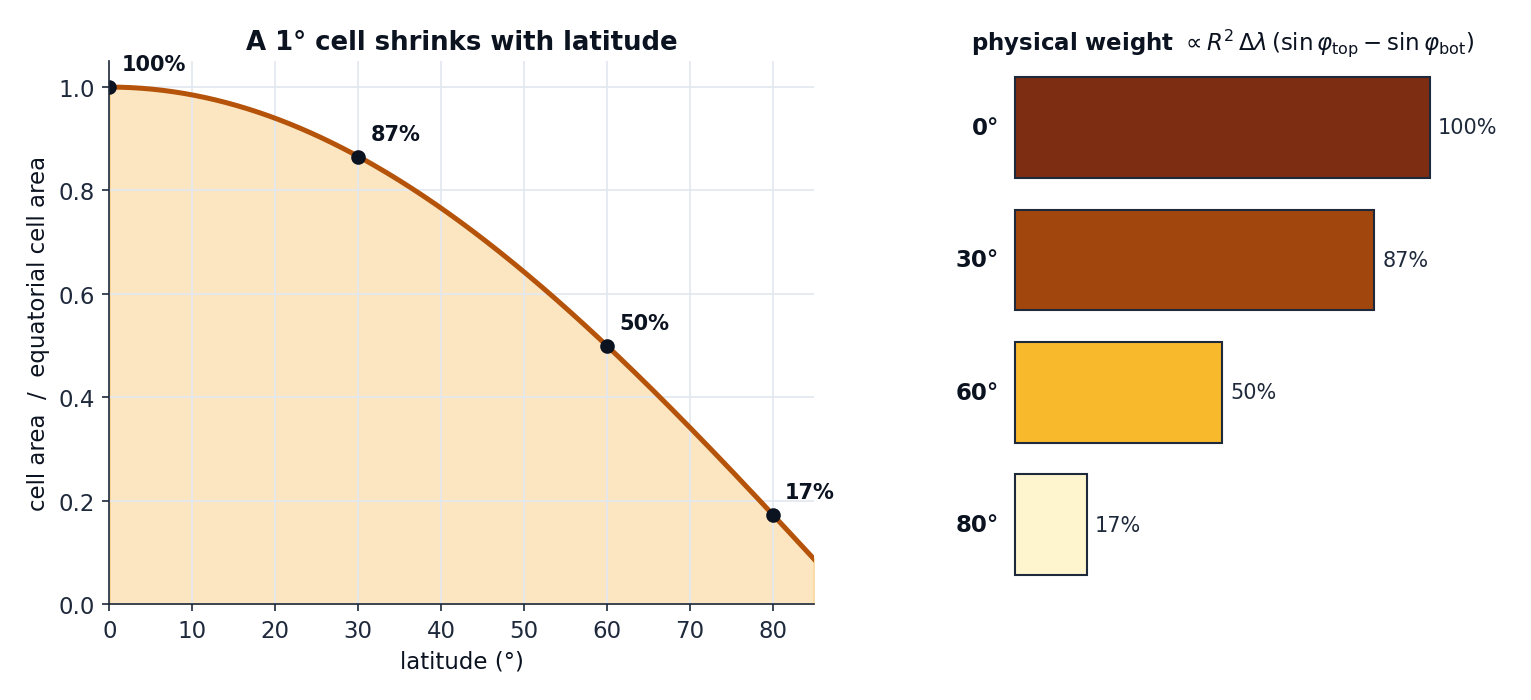
If you treated every cell as equal, high-latitude cells would be over-weighted in the mean — a polygon's average would lean toward whatever its poleward cells happen to say.
The fix
geohalo multiplies each cell's coverage fraction by its true spherical area before row-normalising. The area of the cell between latitude edges \(\varphi_\text{bot}\) and \(\varphi_\text{top}\) and spanning \(\Delta\lambda\) in longitude is the exact integral of the sphere's surface element:
with \(R = 6\,371\,008.8\ \text{m}\) (the mean Earth radius) and angles in radians. The \(\sin\varphi_\text{top} - \sin\varphi_\text{bot}\) term is what bends the curve above: it is the band-area formula for a sphere, exact for the latitude direction.
This is geohalo.geometry.cell_areas:
lat_edges = midpoint_edges(lats)          # N+1 edges from N centres
lon_edges = midpoint_edges(lons)
sin_top = np.sin(np.deg2rad(lat_edges[1:]))
sin_bot = np.sin(np.deg2rad(lat_edges[:-1]))
dlon_rad = np.deg2rad(np.diff(lon_edges))
area_per_lat = (EARTH_RADIUS_M ** 2) * (sin_top - sin_bot)
return area_per_lat[:, None] * dlon_rad[None, :]
Each stencil weight is then coverage × area, so a half-covered equatorial cell
correctly outweighs a half-covered polar cell.
Turning it off
For a planar / equal-area treatment — every cell weight 1.0 — pass
spherical_correction=False:
This makes cell_areas return all-ones and the weights become pure coverage fractions.
It is the right choice when your grid is already on an equal-area projection, or when you
deliberately want unweighted coverage.
Spherical, not ellipsoidal
geohalo uses a spherical Earth, not the WGS84 ellipsoid. The difference in cell area is within ~0.3 %, which is negligible next to the centroid/all-touched bias the coverage choice removes. Ellipsoidal areas are a deliberate non-goal.
Where it folds in
The correction lives entirely inside the stencil build — it is part of
the precompute, so it costs nothing at apply time. The spherical_correction flag is
also mixed into the stencil's cache digest (b"sph" vs
b"flat"), so a spherical stencil and a planar one never collide in the cache.
Polygon areas
Use geohalo.geometry.polygon_areas to measure zones with the same spherical
surface element and radius as cell_areas:
from geohalo.geometry import polygon_areas
from shapely import box

# A GeoSeries or one-dimensional sequence, in longitude/latitude degrees.
area_m2 = polygon_areas([box(-10, 40, 10, 50)])
# With a GeoSeries, the output positions follow its order, including duplicate keys:
# area_m2 = polygon_areas(geoms)
The result is a one-dimensional float64 NumPy array, not an indexed Series.
None produces NaN. Empty geometries, points, and lines have zero area. Polygon
holes are subtracted regardless of winding direction. MultiPolygon and nested
GeometryCollection members contribute additively; collections are not unioned
and overlapping members can therefore be counted more than once. Z is ignored.
Edge convention and integration
Edges are straight in the supplied longitude/latitude coordinate plane, consistent with Shapely's coordinate model. They are not great-circle arcs, and this is not an ellipsoidal geodesic area. For each ring we use the spherical surface integral as a boundary integral:
For a linear edge, let \(m=(\varphi_0+\varphi_1)/2\) and \(h=(\varphi_1-\varphi_0)/2\). Its integral is \(\Delta\lambda\sin(m)\sin(h)/h\), with the ratio defined as 1 when \(h=0\). Thus both horizontal and sloping edges are integrated analytically; adding collinear vertices does not change the geometric area. The implementation subtracts a reference sine and uses a small-angle expansion to reduce floating-point cancellation for small or near-pole polygons.
Longitude and input validation
Longitudes are used as supplied, without wrapping or selecting a shorter arc.
box(-170, -10, 170, 10) covers 340 degrees of longitude, not 20. For a narrow
antimeridian-crossing polygon, unwrap its coordinates (for example, a box from
170 to 190) or split it into polygons on either side of the seam. Each polygon
must span at most 360 degrees; a full globe such as box(-180, -90, 180, 90)
has area \(4\pi R^2\). This helper does not alter the longitude handling of
stencils or reducers.
Coordinates must be finite, latitude must lie in [-90, 90], and geometries must
be topologically valid. Invalid data raises ValueError rather than being repaired
or clipped. Non-geometry elements raise TypeError. A GeoSeries with a declared
CRS must use EPSG:4326 or an equivalent CRS (such as OGC:CRS84); unlabelled inputs
are assumed to contain lon/lat degrees. No reprojection is performed. For planar
area in coordinate units, use shapely.area instead.
Comparing with stencil weights
polygon_areas(geoms) and a spherical stencil's row_sums are expressed in the
same m² and use the same radius, but they need not be numerically identical.
Stencil weights multiply planar coverage fractions by whole-cell spherical
areas. That approximates the spherical area of partially covered cells. A polygon
made entirely of whole grid cells agrees with their summed areas; a partial-cell
boundary generally does not, even if the polygon is a lat/lon rectangle.
The stencil also only includes the portion inside its grid footprint. Ratios
against polygon_areas are therefore approximate coverage diagnostics, not an
exact coverage fraction guaranteed to lie in [0, 1]. This helper leaves existing
stencil construction and reduction results unchanged.