Why exact fractional coverage
The single most important modelling choice in geohalo is how a cell on the polygon boundary is weighted. Three approaches are common, and they disagree most exactly where it matters: along the perimeter.
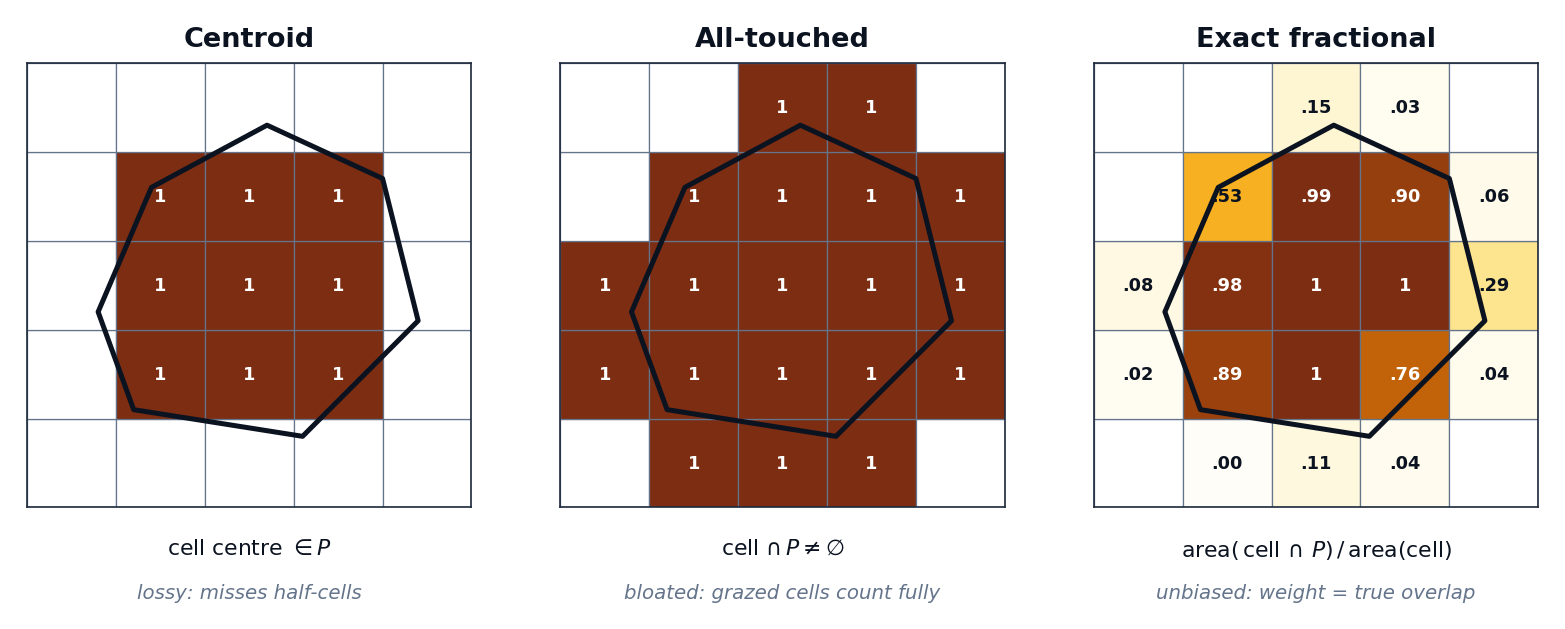
The three methods
A cell counts (weight 1) if and only if its centre falls inside the polygon.
Cheap, but lossy: it ignores how much of each boundary cell is actually covered, and any polygon smaller than a single cell that doesn't happen to contain a centre collapses to zero cells — no estimate at all.
A cell counts (weight 1) if it intersects the polygon at all.
Also cheap, but bloated: a cell the polygon barely grazes is counted as if fully inside, inflating the footprint by roughly half a cell all the way around the perimeter.
A cell's weight is the fraction of its area the polygon covers.
This is what geohalo uses, via exactextract.
A boundary cell that is 30 % inside contributes 0.30; a fully interior cell
contributes 1.0. The weight is proportional to true overlap, so the estimate is
unbiased.
The bias, quantified
| Method | Bias | Cost |
|---|---|---|
| Centroid | High; polygons smaller than a cell collapse to 0 | Cheap |
| All-touched | Overcounts by ~½-cell around the perimeter | Cheap |
| Exact fractional | Unbiased — weight is the true overlap fraction | One-time only |
The errors from centroid and all-touched are systematic, not random: centroid consistently under-samples the boundary, all-touched consistently over-samples it. They do not average out across polygons, and they grow as cells get larger relative to the polygons — exactly the regime of coarse grids over small administrative areas.
Why the cost stops mattering
Exact coverage is more expensive to compute than a centroid test — but in geohalo it is computed once, baked into the stencil, and cached. Every grid afterwards pays the same fast matmul regardless of which method built the weights. You buy unbiasedness at precompute time and never pay for it again, which is why "cheap" no longer recommends the lossy options.
Sub-cell polygons
Exact coverage gives a sensible answer even when a polygon is smaller than one cell: it returns that cell's value (the area-weighted mean of the one cell it sits in). That is the best estimate under a "uniform within a cell" assumption — but geohalo can do better by refining the grid first with mean-preserving downscaling, which uses neighbouring cells to give sub-cell polygons a sharper, still-unbiased answer.